
Category: Forklift Buying Guides
Choosing an electric forklift is only one part of a successful purchase. The truck, battery, charger and facility have to work as one system. If the site review begins after delivery, the buyer may discover that the available power supply, connector, parking layout or charging process does not match the ordered equipment.
This guide helps warehouse managers, procurement teams, electrical contractors and forklift suppliers review the right inputs before an order is finalized. It is a planning checklist—not an electrical design, installation manual or statement that one charging arrangement fits every battery system.
The main rule: specify the truck and the site together
A forklift capacity class does not tell an electrician which charger to install. Two trucks with a similar rated load can require different site arrangements when their ordered battery, charger input, connector, charging method or operating schedule differs.
Before approving the purchase order, connect four workstreams:
- Truck configuration: model, rated capacity, mast, attachment and intended duty.
- Battery and charger package: the exact ordered components and their documentation.
- Facility review: available electrical service, charging location and traffic flow.
- Operating plan: shifts, charging windows, responsibilities and contingency procedures.
The output should be a signed-off configuration and site-readiness record. A marketing brochure or a generic charger recommendation is not enough.
1. Freeze the ordered battery and charger system
Start with written supplier information. Do not infer the battery system from the truck photo, model name or tonnage.
Ask the supplier to identify, for the exact quoted machine:
- battery chemistry and model;
- nominal battery voltage and rated capacity;
- battery dimensions, weight and retention method;
- charger manufacturer and model;
- charger input voltage, phase, frequency and maximum input requirements;
- charger output rating and charging profile;
- truck-side and charger-side connector types;
- whether charging occurs with the battery installed or removed;
- approved charging procedure and operating limits;
- battery and charger manuals supplied with the order;
- destination plug, cable and labeling details;
- warranty responsibilities for the truck, battery and charger.
If any field is configurable, the quotation and purchase order should identify the selected version rather than using a general phrase such as “standard charger.” This prevents the factory, buyer and installer from planning around different assumptions.
Mingbang electric forklifts are configurable. Battery, motor and lift-height choices are reviewed against the application and final quotation. The final charger and site requirements must therefore be confirmed for the ordered configuration—not copied from another CPD model or a previous shipment.
2. Give the site electrical team the right inputs
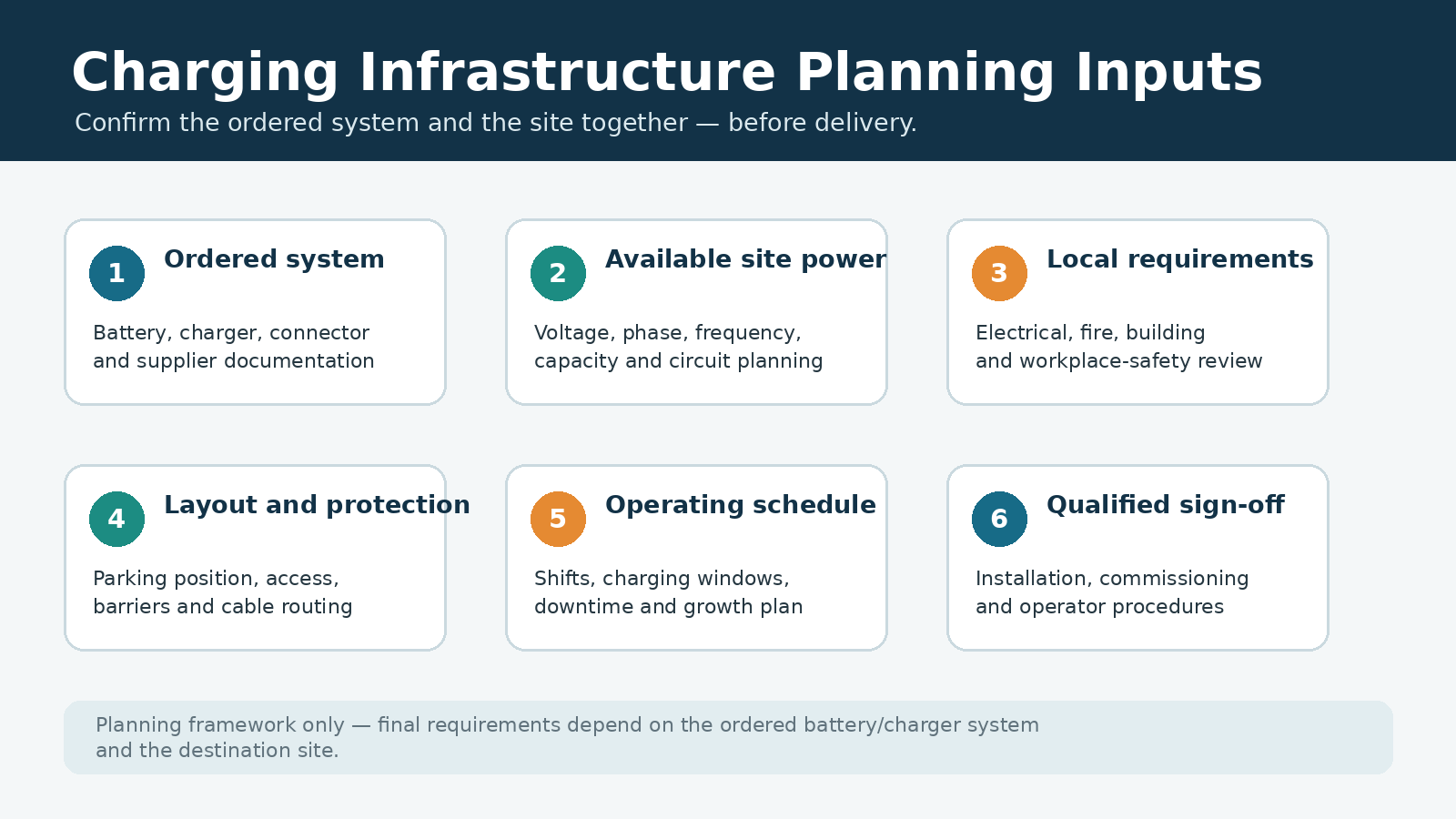
A qualified electrical professional should compare the ordered charger documentation with the destination facility. The review normally needs more than the voltage printed on a wall outlet.
Provide the site team with:
- the charger nameplate or approved data sheet;
- supply voltage, phase and frequency;
- maximum charger input current or power stated by the supplier;
- recommended branch-circuit and protective-device information from the charger documentation;
- connector and cable details;
- proposed charger location and distance from the distribution point;
- the number of trucks or chargers included in the current phase;
- planned future expansion;
- local building, electrical, fire and workplace-safety requirements.
The site team can then assess distribution capacity, circuit protection, isolation, cable routing, mounting, grounding and any permit or inspection requirements. These are project-specific decisions. A forklift supplier should not replace the authority of the destination electrician or local regulator.
Do not authorize an improvised adapter or assume an existing charger is compatible. Written confirmation should cover the battery, charger, connector, charging profile and truck interface as a complete system.
3. Select a safe, workable charging location
The location must support both safety and daily use. OSHA’s U.S. powered-industrial-truck standard states that battery charging installations are to be in areas designated for that purpose. It also addresses protection of charging apparatus, ventilation for fumes from gassing batteries, fire protection and facilities for flushing and neutralizing spilled electrolyte in the relevant battery-charging context.[1]
The exact controls depend on the ordered battery system and the site. Do not automatically apply one battery-room design to every battery chemistry. Instead, review these questions:
- Can the truck enter, park and leave without obstructing an aisle, exit or emergency equipment?
- Is the charger accessible without routing cables across normal pedestrian or vehicle paths?
- Can barriers, curbs or guardrails protect the charger from forklift impact?
- Is there sufficient space to operate the connector without excessive cable tension?
- Does the parking orientation match the actual charge-port or battery-access position?
- Are signs, floor markings and access controls needed?
- Is the surface suitable for the ordered battery maintenance process?
- Are required ventilation, spill-response, fire-protection or emergency facilities available?
- Can maintenance personnel reach the equipment safely?
Crown’s charging-station guidance emphasizes balancing accessibility and safety, protecting equipment and operators, and managing cables and connectors; it also notes that battery technology changes how charging locations may be arranged.[2] TCM likewise highlights secure, accessible charger placement and the need to consider safety equipment and ventilation.[3] These industry sources are planning references, not substitutes for local design approval.
4. Apply battery-specific safety controls
Safety measures must follow the actual battery and charging procedure. For example, OSHA 1910.178 includes provisions for designated charging areas, protecting charging equipment from truck damage, managing electrolyte, battery handling equipment, parking and applying the brake before charging, and preventing flames, sparks or electric arcs in charging areas.[1]
A site checklist should therefore distinguish between items that apply to the ordered system and items that do not. Review at least:
Electrolyte and spill controls
If the battery system involves serviceable electrolyte, confirm the approved handling method, required personal protective equipment, spill neutralization and flushing facilities. Do not describe these as universal requirements for every electric forklift battery.
Ventilation and heat
Use the battery and charger manufacturer’s instructions, charging behavior and local requirements to determine ventilation and heat-management needs. OSHA specifically refers to adequate ventilation for dispersal of fumes from gassing batteries in its battery-charging provisions.[1]
Battery removal and handling
If the operating plan requires battery removal or exchange, verify the battery weight, removal direction, handling equipment, travel path and secure reinstallation method. OSHA addresses material-handling equipment for batteries and proper positioning and securing after reinstallation.[1]
Ignition and impact protection
Define how the area will control flames, sparks and electric arcs where applicable. Protect chargers, connectors and cables from truck impact and mechanical damage. Include these controls in operator training and inspections rather than relying only on signs.
5. Match charging capacity to the operating schedule
The number and placement of chargers should come from the operation—not a universal ratio.
Document:
- number of forklifts in the current fleet;
- actual shift start and finish times;
- expected operating hours and idle periods;
- planned charging windows;
- whether charging is centralized or distributed;
- whether batteries remain in the truck;
- who connects, disconnects and inspects the equipment;
- what happens if a charger or truck is unavailable;
- expected fleet growth.
A multi-shift warehouse may need a different solution from a single-shift operation even when both use the same truck model. Charger quantity should be validated against the approved charging method, the battery/charger documentation and real duty-cycle assumptions. Avoid promising a runtime or recharge time until the final system and test conditions are known.
6. Plan workflow, protection and ownership
A technically compatible charger can still fail operationally if nobody owns the process. Assign responsibilities before commissioning:
| Task | Buyer / facility | Forklift supplier | Electrical / site professional |
|---|---|---|---|
| Confirm application and shift pattern | Lead | Review | Input as needed |
| Freeze battery and charger package | Approve | Lead | Review input requirements |
| Assess site power and protective devices | Provide access/data | Provide charger documents | Lead |
| Approve location and traffic flow | Lead | Review truck access | Review installation |
| Define battery-specific safety controls | Lead | Provide manuals | Verify local requirements |
| Install and commission electrical work | Coordinate | Support equipment checks | Lead |
| Train operators and maintain records | Lead | Provide product guidance | Support site procedures |
The table is a starting point. Contract terms and local responsibilities may differ. Record the final owner for each action and keep the approved documents with the machine file.
Pre-delivery charging infrastructure checklist
Use this checklist before shipment or site installation:
Ordered system
- ☐ Exact forklift model and ordered configuration recorded
- ☐ Battery chemistry, voltage, capacity, dimensions and weight confirmed
- ☐ Charger manufacturer/model and input/output data confirmed
- ☐ Connector type and cable arrangement confirmed
- ☐ Battery and charger manuals received
- ☐ Warranty boundaries documented
Destination power
- ☐ Site voltage, phase and frequency checked
- ☐ Available distribution capacity reviewed
- ☐ Dedicated circuit/protection requirements reviewed
- ☐ Isolation, grounding and cable routing reviewed
- ☐ Permits or inspections identified
- ☐ Qualified installer assigned
Location and safety
- ☐ Charging area selected and marked
- ☐ Truck parking and operator access checked
- ☐ Charger protected from vehicle impact
- ☐ Cable and connector storage planned
- ☐ Battery-specific ventilation reviewed
- ☐ Applicable fire, spill, flushing and emergency controls reviewed
- ☐ Battery handling method approved if removal is required
- ☐ Local electrical, building, fire and workplace rules checked
Operations
- ☐ Shift pattern and charging windows documented
- ☐ Charger quantity validated against the operating plan
- ☐ Failure/backup procedure defined
- ☐ Operator responsibilities and training scheduled
- ☐ Inspection and maintenance records assigned
- ☐ Future fleet expansion considered
Information to send with an electric forklift RFQ
To reduce quotation revisions, send the supplier both application and facility information:
- load weight, dimensions and load center;
- required lift height and rack/door clearance;
- operating surface, gradients and work environment;
- shift pattern and estimated daily use;
- destination country and installation site;
- available site voltage, phase and frequency;
- preferred charging location and operating constraints;
- existing battery or charger equipment, if reuse is being considered;
- required attachments, fork length and quantity;
- requested documents and target delivery date.
If the electrical data is not yet known, mark it to be confirmed rather than guessing. The supplier can then hold the battery/charger selection open until the site professional provides the necessary information.
How Mingbang supports configuration review
Mingbang Machinery currently presents six electric counterbalance forklift capacity classes: CPD-15, CPD-20, CPD-25, CPD-30, CPD-35 and CPD-40, covering published rated capacities from 1,500 to 4,000 kg. Battery, motor and lift-height configurations can be reviewed for the intended application, subject to the final quotation and technical confirmation.
Start with the electric forklift range for available model classes. If the truck itself has not yet been selected, use the electric forklift selection guide first. For facilities still comparing power sources, read the electric, propane and diesel forklift guide.
Request a quotation with the load, lift height, site conditions, shift schedule, destination and available electrical supply. Mingbang can then review the truck configuration and identify the battery/charger information that your local site team needs to verify.
Frequently asked questions
Can I select a forklift charger from the truck’s tonnage alone?
No. The charger must match the exact ordered battery system and its approved charging requirements. Truck capacity class alone does not establish charger input, output, connector or charging profile.
Does every electric forklift require the same type of battery room?
No. The charging arrangement and controls depend on the battery system, maintenance process, charging method, facility and local requirements. In the United States, OSHA requires battery charging installations to be in designated areas and includes specific provisions for relevant charging hazards.[1]
What site-power information should I send to the supplier?
Provide the destination supply voltage, phase, frequency and any known facility-capacity constraints. The supplier should return the exact charger input requirements so a qualified local professional can assess the circuit and installation.
Can I reuse an existing forklift charger?
Only after written compatibility is confirmed for the battery, charging profile, voltage, current, connector and truck interface. A connector that physically fits is not sufficient proof.
How many chargers does a warehouse need?
There is no universal answer. Use the fleet size, shift pattern, charging windows, battery strategy, contingency plan and future expansion to calculate the requirement for the actual operation.
What should I send Mingbang for a configuration review?
Send the intended load and load center, lift height, work environment, shift schedule, destination, available site power, preferred battery/charging arrangement, attachments and quantity. Unknown electrical fields can be marked for confirmation by the destination site team.
Sources
[1] OSHA — Powered Industrial Trucks, 29 CFR 1910.178
[2] Crown — Six Tips for Configuring Forklift Charging Stations
[3] TCM — Forklift Battery Charging Station Power Requirements Explained